

New Year, Same Brain: Why Gentle Resets Beat “New Me” Resolutions
Every January, millions of us try to upgrade our lives—new diets, inboxes, sleep routines—all by Monday. If that worked, gyms and clinics would be empty by March. They’re not.
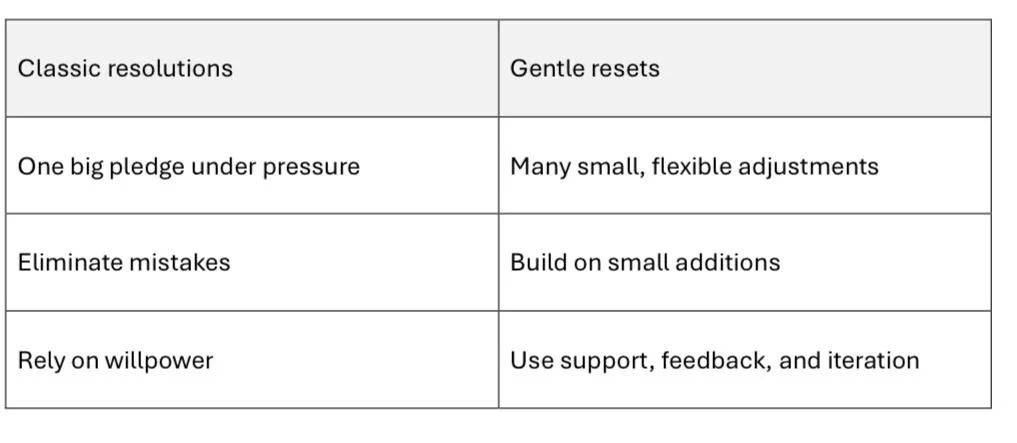
Research shows only a minority fully succeed with New Year’s resolutions; many abandon them within weeks. The issue isn’t laziness—it’s design. Typical resolutions ignore how behaviour and habit actually work.
What the evidence shows
Resolutions aren’t hopeless, but most are poorly built. Goals framed around approach (“walk 20 minutes after dinner”) tend to succeed more than avoidance (“stop snacking at night”). Specific, realistic, and positively framed goals outperform vague aspirations.
Support matters too. Accountability, tracking progress, and flexibility make change sustainable. Behaviour sticks best when it’s collaborative, monitored, and adaptable—not all‑or‑nothing.

Gentle reset: the kind alternative
A “gentle reset” isn’t doing less; it’s designing smarter. Habit research shows small, repeatable actions beat heroic overhauls. A 10‑minute daily walk trumps a “run 5 km from 1 January” plan. The key question becomes: What’s the smallest next step that still moves me forward?
This approach also treats lapses as data, not disaster. Self‑compassion fuels curiosity and re‑engagement, while harsh judgment shuts us down. Think gentle “research” on your own life: small, time‑limited experiments like turning off blue light earlier, stretching between meetings, or taking one slow breath with the kettle.

From resolutions to resets
In truth, a well‑crafted resolution is simply an early‑January version of a gentle reset. The goal isn’t perfection—it’s alignment with how real brains change.
How we’re using this at Prescribed Notes
This year, we’re designing live sessions and content around tiny, kind resets: moments to pause, breathe, and recalibrate. Whether that’s a weekly live session, a minute of music, or a short reflective prompt, each one is a soft nudge toward steadier habits—not a demand for reinvention.
A closing invitation
If you’ve made resolutions, redesign them. Turn one “stop” goal into an “approach” goal. Shrink one ambition to its smallest useful version. Plan your kind response to the first lapse.
And if you haven’t started at all, that’s fine. A gentle reset can begin any day—a random Wednesday, a difficult week, or a quiet evening.
New year, same brain. Change happens gently, with support, one small reset at a time.